From literature
to argument.
The research workspace that maps what the field argues — and helps you build what you argue.
Answer engines summarize. PaperChase holds your corpus, scores it against your question, maps the debate, and turns your evidence into a defensible argument. For researchers who are done reading papers to figure out which papers to read.
Free to start · No credit card required · PhD-grade research tooling
You don't have a
reading problem.
You have a triage problem.
Every literature review tool treats research as an information retrieval problem: find papers, read papers, store papers.
PaperChase is built on a different premise — that literature review is ultimately an argument-construction problem. Researchers don't need more papers. They need to understand how the literature positions their argument, where the gaps are, and which evidence carries weight for their specific claim.
"Relevance isn't a property of a paper. It's a property of the relationship between a paper and your argument."
Built to cut the busywork —
never to think in your place.
A literature review is full of work that doesn't need you specifically: chasing citations, deduplicating results, sorting the relevant from the irrelevant. That's the work PaperChase points AI at. The reading, the weighing of evidence, and the argument you build from it stay yours.
It won't write your argument or invent a source. It clears the tedium so your thinking has room to work.
Four phases, one environment
PaperChase is organized around how research moves — from framing a question to building a defensible argument. Each phase flows into the next, with nothing lost at the handoff.
The Living Literature Monitor watches hourly. New work arrives pre-scored and pre-classified — and if something challenges your central claim, it's flagged as exactly that.
One highlight, week 3 to week 11
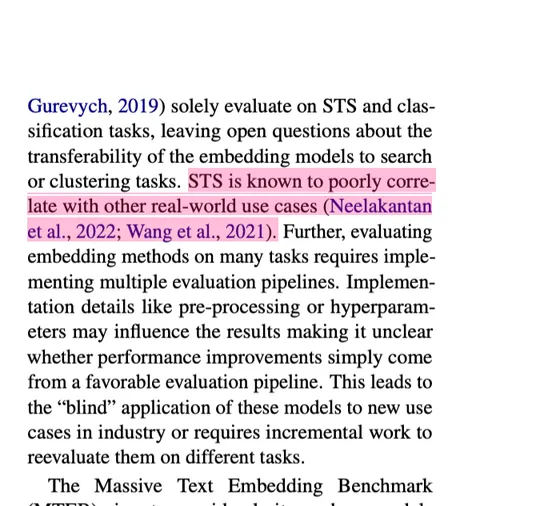
Tuesday, week 3. You highlight a passage in Muennighoff et al.
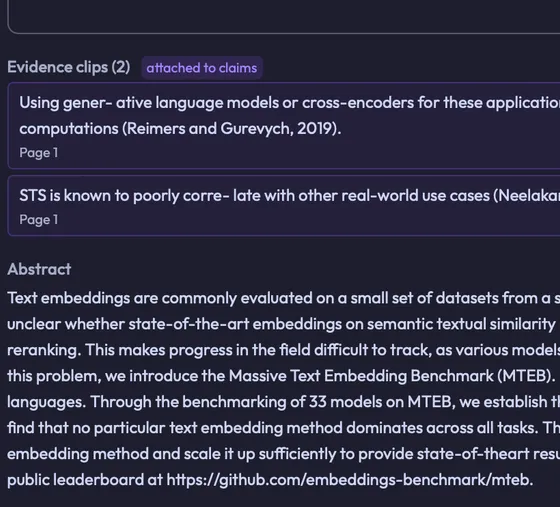
It's stashed as evidence — quote, page, and provenance intact.
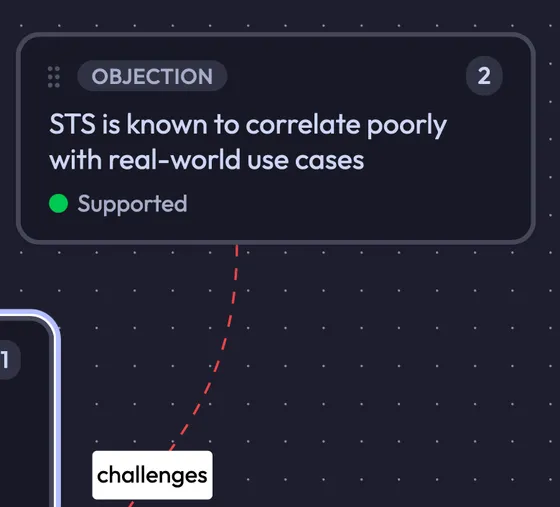
Week 6. It becomes support for the claim your chapter turns on.
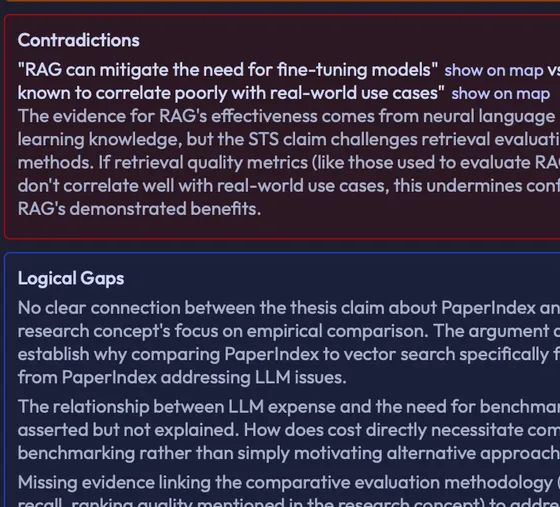
The critique names it your strongest support — and points at the counter-evidence two camps over.
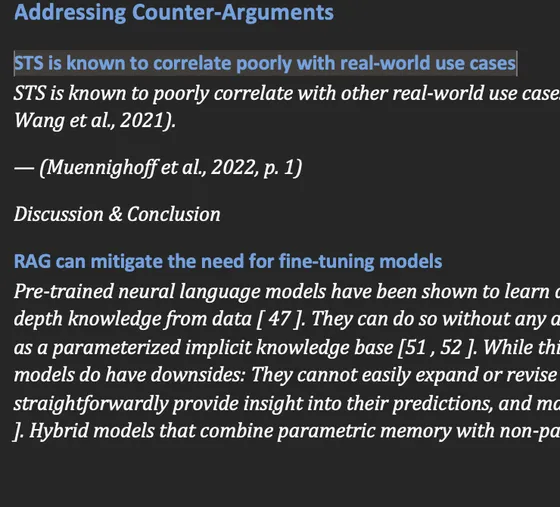
Week 11. It's a cited sentence in the draft you sent your supervisor. You touched it once in 8 weeks.
Every hour in PaperChase is deposited, not spent.
Intelligence at every phase
Trust you can inspect.
Every stance call carries its reasoning and confidence. Uncertain papers are labeled "No clear stance" instead of guessed — and the system behind it is graded against expert panels.
How we evaluate our AI →Scored to your question, not the topic.
The same paper can be foundational to one concept and noise to another. PaperChase scores against your framing, and learns from your overrides.
From 500 papers to a list you can finish.
Trawl, score, and triage before you read. Read the 20 papers that matter before the 200 that might.
A map of the field's actual debate.
Camps, stances, reasons, and confidence — refreshed as new work arrives without churning what you've studied, shareable as one read-only link.
Your argument as an object.
Claims on a canvas, evidence attached from your PDFs, a critique that finds the thin spots, a DOCX draft at the end.
Where reading becomes an argument
Every other tool stops at "here are the relevant papers." PaperChase keeps going — into the work of turning those papers into a position you can defend.
The complete arc from citation to argument
Answer engines answer questions. PaperChase builds your argument.
Zotero stores your papers. Elicit answers questions about them. PaperChase turns them into your argument.
| Tool | What it does well | Where it stops |
|---|---|---|
| ChatGPT Prism / Gemini Deep Research | Free, fast, well-written field summaries | One-shot. No corpus, no memory of your judgments, no argument state |
| LeapSpace (Elsevier) | 18M paywalled full-text articles; Trust Cards; institutional security | Citations you may need a separate subscription to read; chat-first; no researcher-built argument structure; $32/mo |
| Elicit | Systematic screening at scale (5,000 papers on Pro); column extraction | Extraction tables, not arguments; no PDF retrieval; $49/mo at the tier that matters |
| SciSpace | Paper-by-paper reading help; broad multi-source search | Paper-centric — a question spanning 40 papers means 40 tab switches |
| Consensus / Scite | Fast evidence checks; citation-context classification | Answers about the literature, not tools for your position on it |
| Paperguide / PapersFlow / Atlas | Agentic search → screen → draft pipelines | The draft is the endpoint. The researcher's own claim structure never exists as an object |
| ResearchRabbit / NotebookLM / Zotero | Free; graphs, notebooks, reference management | No intelligence about your specific argument |
| PaperChase you are here | The persistent arc from corpus to defended argument | — |
What researchers say
I used to spend entire afternoons just figuring out which papers deserved a full read. PaperChase’s argumentation roles changed that completely — I can see which papers challenge my central claim before I even open them.
The Living Literature Monitor means I’m not anxious about missing something anymore. New papers that meet my threshold just appear, already scored. It’s changed how I think about ongoing research management.
PaperChase surfaced a paper I’d never have found that directly challenged my central claim. I’m glad I found it before my committee did. That alone justified everything.
Free runs the whole workflow on one concept, forever.
Pro is $19.20/month billed annually.
See pricing →Fair questions
"ChatGPT does this for free."
It does the first afternoon for free — orientation, summaries, a reading list. It cannot hold your corpus, your scores, your highlights, or your claim graph next Tuesday. If your review takes a week, use ChatGPT. If it takes a semester, you need state.
"Why not LeapSpace? It has the paywalled papers."
It has 18 million of them — about a fifth of recent literature — and when it cites one you don't subscribe to, reading it is a separate purchase. Roughly half of current research is open access; PaperChase fetches those PDFs into your workspace and syncs the library you already own. Different bet: they rent reach, we build your argument. Some researchers will want both.
"How is this different from Elicit?"
Elicit is the best systematic-screening tool on the market — structured extraction at volume. PaperChase is for the argument after the screening: the debate map, the claim canvas, the critique, the draft. If your deliverable is an extraction table, use Elicit. If it's a defended position, that's us.
"Another subscription?"
The free tier runs the full workflow on one concept, indefinitely. And everything exports: BibTeX, Markdown, DOCX. No hostages.
"Can I trust the AI's stance calls?"
Check them. Every placement shows its reasoning and confidence. Uncertain papers are labeled "No clear stance" rather than guessed. And the system behind it is graded against expert panels with releases gated on regression — the methodology is published. Distrust of unaccountable AI is correct; that's why we built the accounting.
"What happens to my work if I leave?"
It leaves with you. BibTeX for references, Markdown and DOCX for writing, the corpus is exportable. We'd rather earn month 13 than lock it in.
Start building your argument.
Bring your foundational papers. PaperChase handles the triage from there.
Free plan available · No credit card required · Built for researchers